Saturday, January 10, 2009

Pictures From Nenagh

I have recently put together a series of pictures from my home town, Nenagh, which I have taken over the last few weeks. Also, there are a couple from the nearby towns of Cashel and Holycross.
I know those pictures are not everyone’s cup of tea but I never tire of taking pictures of the impressive buildings around Nenagh. It is a town rich in history and its buildings form part of its many historic attractions.

13th Century Nenagh Castle. A project is currently under way to develop the castle and its surrounds. This project will position the castle as the main tourist attraction in the area.

St Mary Of The Rosary Parish Church. This neo-gothic church was built in 1895 to a design by architect Walter G Doolin. It was constructed by John Sisk using local stone and slate with the Portland stone of the arches being the only imported material

Nenagh Courthouse. Nenagh Courthouse was built in 1843 to the design of Architect John B Keane.

Another View of the Courthouse which shows the one remaining old jail cell block and the octagonal governor's residence which is now happily reduced to a museum. In front of the courthouse you can see the monument to the three Olympic Gold Medalists who came from Nenagh.

Twenty or so miles from Nenagh stands the famous Holy Cross Abbey. The Abbey is a restored Cistercian monastery in Holycross near Thurles, County Tipperary, Ireland, situated on the River Suir. It takes its name from a relic of the True Cross or Holy rood.

Rock of Cashel

Tuesday, November 18, 2008

Nenagh Castle

I have been asked by a reader if I would give an update on the status of the restoration work on Nenagh Castle.

Well Aaron, in answer to your question about whether the castle is presently open to the public, I’m afraid we appear to be a little away from that yet, but the good news is that – according to an article in this week’s Nenagh Guardian – a new timeframe of two years has been given for the opening of Nenagh Castles visitors centre.

New revised plans for the project have been drawn up and a planning application for the Nenagh Castle Project will be lodged with Nenagh Town Council before Christmas and subject to planning approval, work will begin on the site by September 2009.

I’m sure this is welcome news to all the local representatives who has put so much time and effort into the furtherance of the project.

Nenagh Castle shrouded in scaffolding. Picture taken at nightfall tonight

I note from your communication that you are in Ireland at the moment and would like to visit the castle. Well don’t let the fact that it is not yet open to the public deter you from visiting our town. We have lots of beautiful sights and places of interest in Nenagh and its surrounds that I’m sure you would enjoy paying a visit to.

Thank you for your comment and I hope you will enjoy your visit to Ireland and hopefully Nenagh as well.

St Mary's Of The Rosary Church, Nenagh

Monday, May 12, 2008

Nenagh Castle Restoration

After years of hard work and persistence by successive Town Councillors and Nenagh Tourism Committee, it now appears that their diligence and commitment have paid off with work well under way on the restoration of the 13th Century Nenagh Castle and visitors centre.


I understand that the work which is being carried out by The Office of Public Works (OPW) has made considerable progress. Wooden oak beams which will support the four floors have been installed and the castle now has a roof for the first time in centuries.


Nenagh Castle is recognised as the finest cylindrical keep in Ireland was built in 1200 Theobald Walter, the founder of the great Butler dynasty of Ormond. It formed the north corner of a pentagonal court with a towered gatehouse on the southern side and strong towers on the north-west and south-east angles. This has now vanished, except for fragments of the gatehouse and east tower, but the keep still stands proud to a height of 100 feet. Its topmost quarter was added about 1860 by the Bishop of Killaloe in emulation of Windsor Castle.


Work on the restoration was recently delayed due to an archaeological find claimed to be of "huge historical significance". The find is believed to include a curtain wall of the 13th century castle and the ruins of a medieval manor house.


The castle adorned in scaffolding. The scaffolding was specially designed to allow architects full access to the walls which will enable them to inspect the structure and plan the work needed to be carried out.

(click to enlarge)

Monday, April 7, 2008

Pictures from Nenagh Past...4

Tyone Abbey

The Priory and Hospital of St. John the Baptist was founded in 1200 AD by Theobald Walter, the first Butler. It was erected following a Grant from Butler to the Augustinian Hospitaliers upon certain conditions.

Among those conditions, unique in Ireland, was that the Augustinians should be Englishmen and that they should establish a hospital for the care of thirteen infirm persons and support them with sufficient food and drink from the cellar and a mess from the kitchen.

The Priory was dissolved at the time of the Reformation c.1550 AD.

The Seal of the Monastery/Priory survived until at least 1917 when it was known to be in the possession of a Mr. W.H. Patterson of Belfast. The Seal, which is of 13th Century origin, bears the inscription: S HOSPITALIS-IER NENAGH. Its present whereabouts is now unknown.

The Abbey is now recorded as a National Monument and the surrounding field is protected as a Record of Monuments and Places.

Sources: E.H. Sheehan: D.F. Gleeson, Department of Heritage: Ger Lewis.

Friday, March 28, 2008

Pictures from Nenagh Past...3

The Spout

The Spout is another historical landmark in the history of Nenagh. It is situated in a part of the town, variously known as McDonagh Street, Dublin Road, Spout Road. It is recorded in land deeds of 1737 as Tubberfalliny. The name Spout Road is mentioned in the 1788 Directory.

The waters of the spout, described as “the best and purest in Nenagh” supplied the residents of its neighbourhood with drinking water for at least 200 years and undocumented oral tradition records its existence in Cromwelliam times.

During a famine of 1881, there was widespread failure of crops in the Nenagh area, including potatoes which were the staple diet of the masses. Conditions, i.e., lack of food, unemployment, housing, and clothing for the labouring classes were dire. Relief committees were formed in Nenagh and an application was made for financial support to a voluntary London group called the London Tavern Society. There was a speedy and favourable response to the request and the aid granted allowed the local relief committee to employ men, women and boys which afforded them a meagre wage to buy essentials.

Amongst the work undertaken was the erection of a stone edifice and steps surrounding the spout, or pipe, that disgorged the water. A plaque thanking the benefactors was erected.

The pipe or spout that disgorged the pure water


New plaque that was erected at the time of restoration

The Spout continued to be a public water facility until 1936 when the Public Health Department closed it claiming the water was impure.

The edifice fell into disrepair through neglect, but in 2007 it was reconstructed through the work of a local voluntary committee and the Town Council.


Lest anyone be tempted to blame the youth of today for the graffiti which can be plainly seen on the facade of the edifice, I would like to point out that that inscription is there a long number of years. The youth responsible went on to be a very notable businessman. He, and his brother, ran a very successful printing business in the town until his retirement a few years ago. Perhaps his talents as a printer were coming to the fore when he felt compelled to inscribe his name for posterity so many years ago.

Monday, March 17, 2008

Pictures from Nenagh Past...2

Old Military Barracks, Nenagh
This imposing ruin began its role as a military complex in 1832 and was garrisoned by regiments of the British Army until 1922 when the Irish Free State was formed. The complex was briefly occupied by the Irish Army until 1924.

In the military arrangements of the time, it was one of nine military stations in County Tipperary. There were four for cavalry, at Cahir, Carrick-on-Suir, Clogheen, and Fethard; four for infantry, at Cashel, Nenagh, Roscrea, and Templemore (now the Garda training depot); and one for cavalry, artillery and infantry at Clonmel. The whole were capable of accommodating 139 officers and 2935 men.

A revolt which occurred here in July 1856 deserves mention as it may well be described as one of the most outstanding events in the history of Nenagh. The townspeople of Nenagh, then and now, are never found wanting when it comes to giving a name to an unusual occurrence or event. True to form, this particular revolt – serious though as it was - went down in history by the whimsical but appropriate name of the “The Battle of the Breeches”

The cause of the revolt was simple and, without going into too much detail, it occurred in a regiment of the North Tipperary Militia who were stationed here for training during the Crimean War. On their enrolment, the Irish recruits were promised a bounty but when peace was declared and the Government had no further use for them, they refused to pay the bounty.

When the order was given for the soldiers to give up their uniforms, one man refused to give up his black trousers whereupon he was immediately arrested and confined to the guard-house. The revolt that followed when his comrades tried to rescue him lasted several days and spilled over into the town. “The shops are all closed, business is suspended and the town appears like a place besieged”. The revolt was eventually quelled by force of arms and mediation and the Authorities agreed to honour its commitments.

No revolt or mutiny is without its consequences and in the ensuing General Court-martials, one ringleader was sentenced to death, five others to transportation for life and three more to 21 years transportation. The death sentence was later commuted to transportation for life and the eight others to ten and four years.

The latter judgement recorded the following against the officers in charge: “Had they not sought to cast off the Irish recruitss, hungry, penniless and naked, the mutiny would have never had an existence”.

I like this view of the old Military Barracks from my bedroom window. Mainly, because it is part of the history of the town.

Friday, March 14, 2008

Pictures from Nenagh Past


In this post I have decided to post some pictures of historical buildings from Nenagh's past and present giving a brief description of their history and how those buildings have shaped the history of the town and surrounding areas

Of course the oldest and most historical building in Nenagh is Nenagh Castle. Following the Norman invasion in 1169, one Theobald Fitzwalter (also known as Butler) began the erection of this fortress in the opening years of the 13th century, in or about 1215. The Butlers lived in this, their chief stronghold, up to the middle of the 14th century until, owing to an uprising of the local O'Kennedy's, they were forced to leave and thereafter resided in Kikenny

The Keep before the crown was added in 1861. Source, Walkabout Nenagh.

The castle underwent a transformation in 1862 when the battlemented ornamental crown was added. At that time, it was intended that this would serve as the belfry for a new cathedral that was planned for the town. For various reasons, the plans for the cathedral fell through and thirty years after, the beautiful church that we now know as St. Mary's of the Rosary was built.


Another impressive ruin is that of the Franciscian Friary which was founded by the O'Kennedy's less than a century after the Norman Theobald Fitzwalter's arrival. The Annals of Nenagh, which recorded local and national events, were compiled here. The entries cover the period 1336 to 1528. The original manuscript is missing, but a copy of it made some centuries after it was written still survives in the British Museum Library, London. This dominant building is the well-preserved bell tower and gateway of a former Church of Ireland church. The tower has the year 1700 inscribed on a slab just below the capstone on the graveyard side. Inside, attached to the tower, is a roofless mortuary chapel with lancet windows. It is all that remains now of the building which was reconstucted in 1809 and dismantled shortly after the completion of the parish's new Church of Ireland church in 1860.
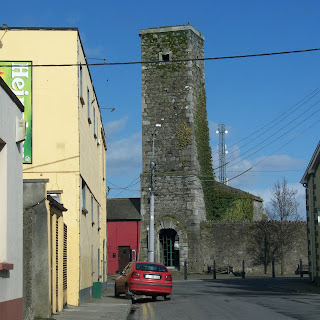
The burial ground is inter-denominational and is the resting place of many well-known Nenagh citizens. The grave stones have many interesting inscriptions which I will feature in a future post.
One which I found interesting is to a young Ensign and Adjutant, named Neil Murray, who was accidently shot on maneuvers in 1811. It reads as follows:

A Random Shot Consigned Thee To This Grave
Murray, Farewell! Companion True and brave
Thy Laurels Won In Egypt Flourish Here.
My thanks to Local historians and authors Donal and Nancy Murphy for their kind permission in allowing me to use material from one of their many publications, Walkabout Nenagh, and to Ger Lewis for his invaluale help in providing me with other material for this blog.